


Gender workshop: who decides about the river?
In an earlier post we shared that Makara is Wilde Ganzen’s Gender & Inclusion Ambassador for 2026-2027.
As founder, I fulfil that role. On Friday 30 October I was therefore a guest at Wilde Ganzen in Amersfoort, the Netherlands, for the workshop “Inclusive and effective project design”. The participants represented various Dutch foundations with projects abroad. They asked questions about our work.
A distorted picture
I was there to explain why gender is an important theme in our work. I have worked with both men and women in Indonesia for a very long time, and I was not aware of the differences. It is true that I mainly work with highly educated Indonesians. That gave me a distorted picture. This changed through our work along the Brantas River in East Java. Especially in the remote villages, patriarchal norms are stronger and women are less free. Child marriages still occur, and women have no access to the village meeting.
For a project with TU Delft, we studied how villagers view the roles of women in river management. Men and women turned out to agree: waste management and childcare are women’s tasks. It is the women who are the first to see their children swimming among the plastic. And they want to change that. Precisely because the role of women is clear here, they can take the initiative and make proposals to the government, for example in the village meetings they normally have no access to.
Equal on paper, not in practice
For me, gender comes down to one thing: to what extent do women in village communities take part in decisions? On paper, women in Indonesia have the same rights. In practice it is different: no access to information, no access to village meetings, and a village head who does not care about the water quality of the river. Excluding women harms the community: they are the first to see the pollution, and they often come up with solutions. Their involvement is therefore essential.
Five phases, five questions
Next I spoke about the AKSI Brantas approach. We developed this approach between 2019 and 2024 together with our Indonesian partner ECOTON. With it, women’s groups along the Brantas learn to measure pollution themselves, report it and propose solutions. It is important that women truly take part in decisions in those communities.
I showed how ECOTON and Makara work with women’s groups along the Brantas in East Java, following the five phases of a project. Each phase comes with one question. Who names the problem? Who decides about the money? Who does the talking? Who defines success? And what stays with the people themselves?
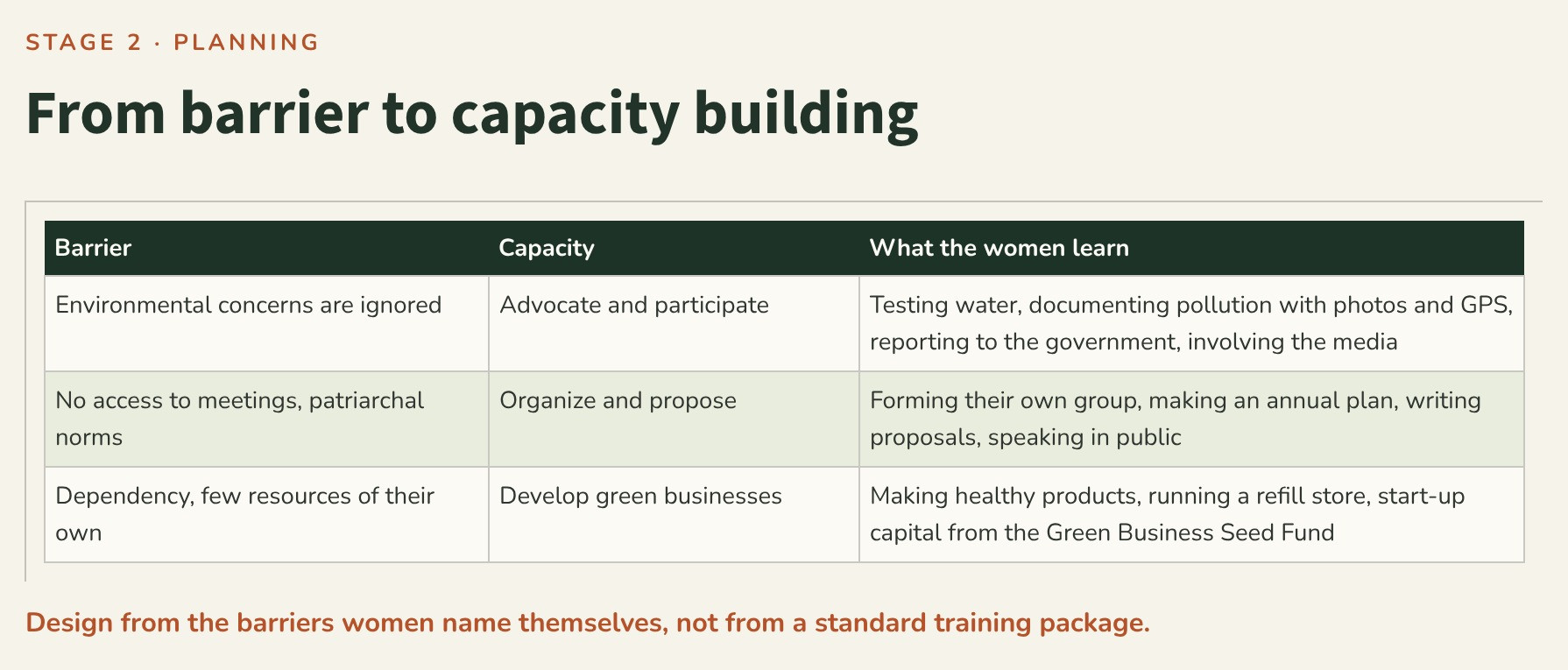
In the AKSI Brantas approach, the women name the barriers themselves: a village government that ignores waste and riverbanks, resistance at home, no invitation to the village meeting, or being allowed to attend without being heard. Those barriers are the starting point. Each barrier is matched by a capacity the women strengthen: standing up for their environment, organising and making proposals, and setting up their own green business.
Who does the talking?
Becoming visible comes at a price. Anti is one of the women of the forest cooperative KEPUH. She recorded the illegal felling of 17 trees with a GPS camera. The logger threatened the village.
“We encounter intimidation, threats, yet we remain steadfast.” Anti, KEPUH
The women persisted. With support from ECOTON, they reported the logging themselves to the Ministry of Environment. The result: a collaborative forest management agreement between KEPUH, the village head and the state forestry company Perhutani. That is remarkable. The same village head had not invited the women to the village meeting before. Now they sit at the table themselves. Read the full story of the women of KEPUH.
Who defines success?
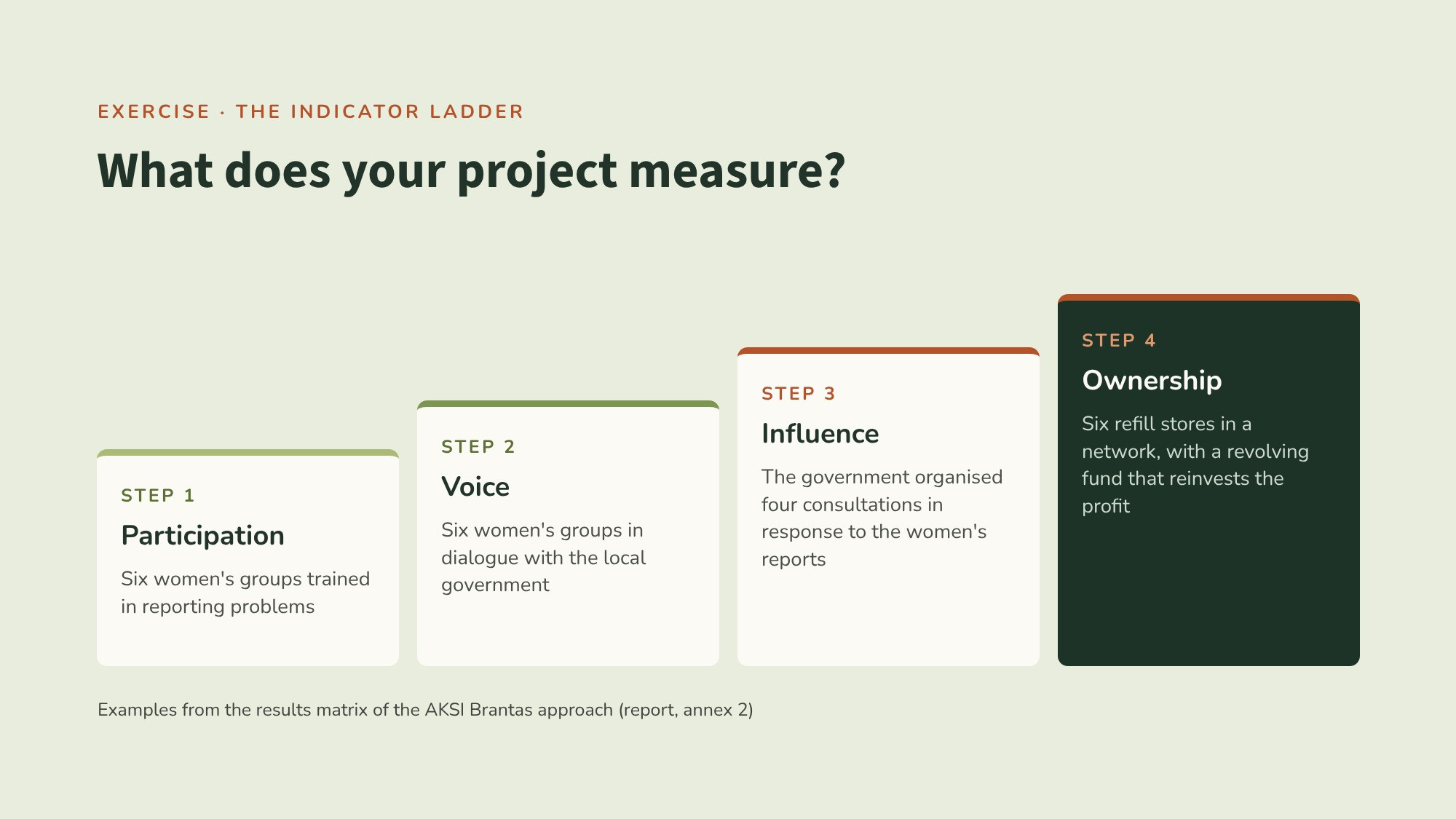
Usually the donor or the organisation decides when a project has succeeded. In the AKSI Brantas approach, six women’s groups set their own goals and indicators.
In the workshop we used a ladder with four steps. On the first step, participation, you count how many women attended a training. On the second step, voice, the women’s groups themselves hold talks with the local government. On the third step, influence, the government starts to move: it organised four consultations in response to the women’s reports. On the fourth step, ownership, women themselves run six refill stores, with a fund that reinvests the profit.
Most projects mainly measure the first step. That is a start, not the finish. At each table, participants discussed how the ladder could improve their own project.
Questions for ECOTON and the women’s groups
The participants found the story inspiring. That compliment goes above all to the women’s groups along the Brantas and to ECOTON. The participants wrote their questions on sticky notes. Have the women’s groups ever faced opposition? Yes, Anti’s story shows it. The report on the AKSI Brantas approach has more examples, and also describes the support ECOTON offers. Can ECOTON apply its knowledge elsewhere? Yes again. The approach is now moving to the Balantieng River in South Sulawesi, as AKSI Balantieng. In four villages there, waste management is now part of the village budget.
We will put the other questions to ECOTON and the women’s groups. How do you deal with intimidation, for instance by people involved in illegal logging? How do you make local governments see the urgency of funding and supporting the work? And do ECOTON and the women’s groups make their success the local government’s success too? We will share their answers on this website soon.
Thanks to Josje van de Grift and Corine Aartman of Wilde Ganzen for the invitation, and to all participants for their sharp questions. Read more about the AKSI Brantas approach on the page Women leading river protection.
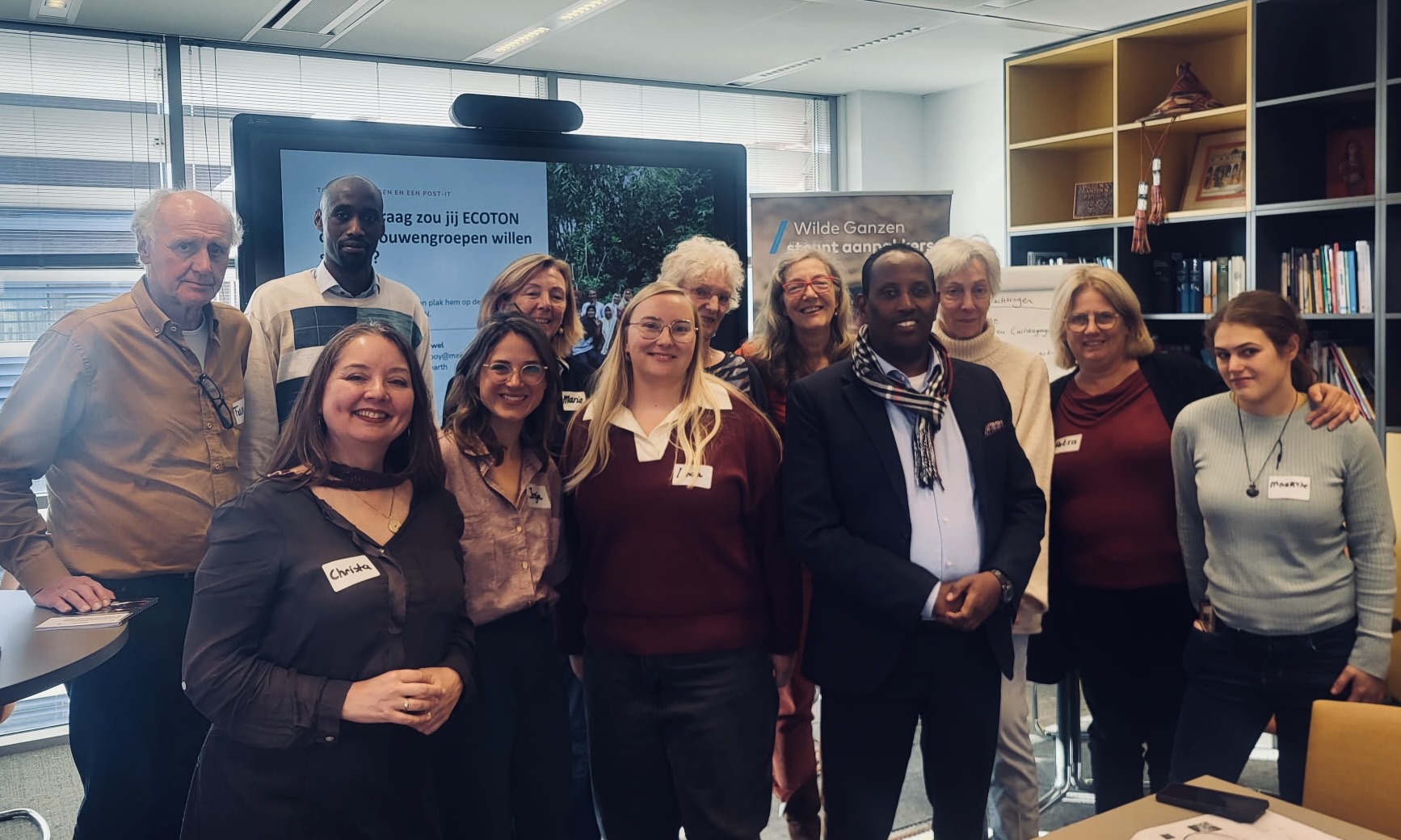
Participants of the Wilde Ganzen workshop in Amersfoort.